
Image Creator: Tim de Waele | Credit: Getty Images
Recent incidents
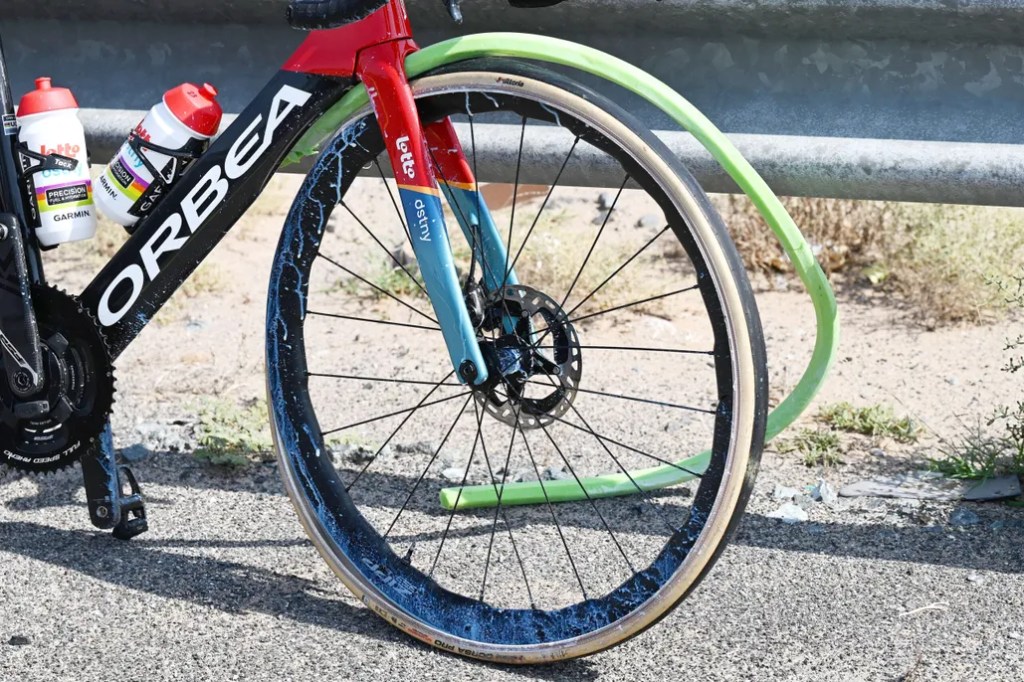
The use of hookless rims in professional cycling has come under intense scrutiny following a series of of recent high-profile incidents where tyres have become detached from wheels. At the UAE Tour, Thomas De Gendt from Lotto-Dstny crashed during Stage 5 after his front tyre detached from a Zipp 353 NSW wheel featuring hookless rim technology, reportedly after hitting a rock. Johannes Adamietz, also of Lotto-Dstny, experienced a similar incident at Strade Bianche when his front tyre detached from the same wheel. These incidents catalyzed a response from the Union Cycliste Internationale (UCI), which oversees regulatory compliance in the sport.
What is hookless technology?
Hookless technology refers to a design of bicycle rims where the traditional hook on the inner edge of the rim bead seat is removed. In a standard hooked rim, the tyre bead hooks onto the rim, providing an additional layer of security and preventing the tyre from blowing off at high pressures. Hookless rims, on the other hand, have a straight sidewall which can simplify manufacturing (resulting in cost savings) and purportedly offer aerodynamic advantages due to a smoother interface between the tyre and rim.
The hookless design requires the tyre to rely solely on air pressure and the tight fit of the bead against the rim to stay in place. This design mandates precise compatibility between the tyre and rim to ensure safety, making adherence to standards from the International Organization for Standardization (ISO), and the European Tyre and Rim Technical Organisation (ETRTO), crucial.
Zipp’s response and technical compliance
Zipp, the manufacturer of the hookless wheels used by De Gendt and Adamietz, has defended the safety of their products, arguing that the incidents were due to external impacts rather than any fundamental flaw in the rim design. Zipp claims their rims meet rigorous testing standards established by both ISO and ETRTO. These standards specify critical parameters such as maximum tyre pressure and rim-tyre compatibility to ensure safety.
The adoption of hookless rims among manufacturers varies; however, several major brands like Zipp, ENVE, and HED have integrated hookless designs into their high-performance road wheelsets. All manufacturers emphasize the importance of using tubeless tyres specifically designed for hookless rims to mitigate the risk of blow-offs.
ISO 5775-2:2021 and ISO 5775-1:2023 set forth detailed guidelines on the compatibility of tyre and rim widths, crucial for maintaining safety in hookless setups. The ETRTO standards complement these by defining maximum pressure limits, which for hookless rims should not exceed 73 psi.
Deviations, such as using incorrect tyre sizes, can lead to failures. In De Gendt’s case, his team used a 28c tyre on a rim with a 25mm inner width (which ETRTO standards state requires a minimum tyre size of 29c). However, while Zipp is now advising the pro teams it sponsors to adhere to ETRTO standards, it continues to insist that 28c tyres are safe for use on rims with a 25mm inner width.
Never missing a commercial opportunity, Zipp have now collaborated with specialist tyre manufacturer Goodyear to release two new tyres available in 30c size designed specifically for hookless rims with a 25mm inner width, that will meet ETRTO standards whilst maintaining aerodynamic performance (the likely reason De Gendt was using a 28c tyre).
The UCI’s position
The UCI promulgates extensive regulations governing the equipment used in professional cycling. Article 1.3.018 of the UCI Regulations mandates compliance with ISO standards for all cycling equipment. Furthermore, Article 1.3.002 highlights the necessity for all equipment to meet safety requirements verified through testing and certification.
In a press release of 28 March 2025, the UCI emphasized the need for adherence to ISO standards, and stated that it considers that the failures by teams to so adhere may have been a contributing factor in the incidents involving De Gendt and Adamietz. It has also set a medium and long-term strategy regarding the use of hookless within the pro peloton.
In the medium-term it has mandated SaFeR (an entity formed last year which brings together various stakeholders of professional road cycling) to work with all parties, including teams, riders, and the cycling industry. Its aim is to explore potential improvements and clarifications on the use of hookless rims, including potential updates to the UCI Technical Regulations to ensure they are in harmony with ISO and ETRTO standards. In the longer term, the UCI plans to conduct a thorough review of the appropriateness of current equipment requirements, particularly wheels, to adapt to technological advancements while maintaining rider safety. This approach aims to reduce reliance on manufacturers’ internal diligence processes and ensure independent verification of equipment safety.
Comment
From a legal perspective, recent incidents highlight the critical importance of regulatory compliance and the potential liabilities for teams and manufacturers of failing to do so. Teams must ensure that their equipment not only complies with UCI regulations but also aligns with broader ISO and ETRTO standards. Any deviation that leads to a serious injury of a professional rider could potentially expose them to significant liability. Manufacturers, on the other hand, need to validate their products’ safety through rigorous testing and certification processes to avoid legal claims and maintain trust within the cycling community.
The ongoing debate about hookless rims in professional cycling underscores the need for proper regulatory oversight and safety measures to protect riders. With SaFeR due to provide their recommendations on hookless rims in the coming months, the author will be keeping an eye on changes to the UCI Regulations regarding the use of hookless rims in advance of the 2025 season.
Words: Nick Williams

 Cycle Counsel
Leave a comment