
The Union Cycliste Internationale (UCI) has announced the introduction of a yellow card system aimed at bolstering safety in professional cycling. The initiative, inspired by similar systems in sports such as football, forms part of the UCI’s efforts to address growing concerns about rider safety following numerous high-profile crashes. A trial phase for the system will run from 1 August 2024 to 31 December 2024, with full implementation slated from the start of 2025. This article explores the purpose and function of the yellow card system, potential issues, and broader safety measures which are being introduced in parallel.
Purpose and function of the yellow card system
Objectives
The yellow card system is designed to tackle unsafe or undesirable behaviours by providing a structured method of recording and penalising ‘race incidents’ within the meaning of Article 2.12.007 of the UCI Regulations. Unlike physical yellow cards shown on the field in other sports, infractions will be documented in race communiqués published after the finish. The new card system is intended to plug the gap where a relegation or disqualification might be inappropriate, and monitor undesirable behaviour over time.
When may a card be imposed?
A yellow card may be applied in respect of any race incident. These include a wide range of sanctionable behaviours, from relatively minor infractions like littering, to major infractions like engaging in physical altercations with other riders or spectators. They may be handed out to anyone present in the race convoy including riders, Sports Directors, and drivers of team cars.
The new system creates no new offences, but rather introduces a system for monitoring and ultimately penalising the conduct of individuals over time. The cards may be imposed either as a standalone sanction, or in addition to the existing sanctions set out in Article 2.12.007. Disqualification (which would represent a ‘red card’ in other sports) is one such existing sanction.
Suspension for multiple cards
During the trial phase of the system, yellow cards will be monitored, but no consequences will flow from accumulating them. This approach is intended to allow the UCI to keep tabs on undesirable behaviour and gather data without immediately affecting race outcomes. However, from 1 January 2025, individuals accumulating multiple yellow cards will face the following consequences:
- During the same race, anyone who receives 2 yellow cards will be disqualified from that race and suspended for 7 days, starting on the day following receipt of the second yellow card.
- Anyone who receives 3 yellow cards within a 30-day period will be suspended for 14 days, starting on the day following receipt of the third yellow card.
- Anyone who receives 6 yellow cards within a one-year period shall be suspended for 30 days, starting on the day following receipt of the sixth yellow card.
A yellow card that has been taken into account for the imposition of a period of ineligibility shall not be taken into account in the future for the purpose of imposing a future period of ineligibility. Much like a driving ban in the UK clears points on a licence, a suspension wipes the slate clean.
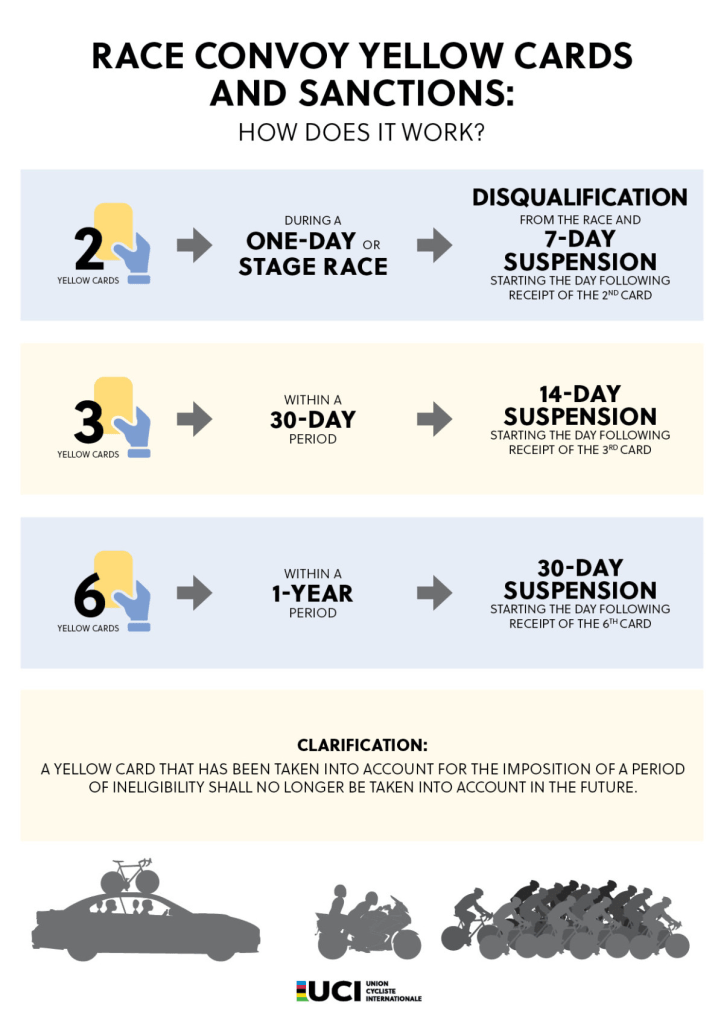
Image Credit: Union Cycliste Internationale
Potential issues with the yellow card system
Consistency and fairness
One of the main challenges with the yellow card system will undoubtedly be ensuring consistency and fairness in its application. The subjective nature of commissaire decisions will undoubtedly lead to inconsistencies. Although that is hardly a new issue, ensuring that the rules are applied as uniformly as possible across all races and all riders, no matter where they have finished in the race, will be crucial for ensuring its success.
The commissaires will not be assisted in that task by the fact that the card system is discretionary, rather than automatic in respect of any race incident. Whilst that flexibility might avoid a rider being removed from a 21-stage race for (say) littering on two occasions, it is likely to result in a huge variance as to when cards are handed out. One rider might receive a number of yellow cards across a period for a series of relatively minor infractions and receive a suspension, whereas another rider might commit more serious acts across a longer period and will not.
Application and proportionality
The detailed application of the yellow card system also raises questions. For instance, the rules state that a rider receiving 2 yellow cards during a stage race will lead to a 7-day suspension, counting them out of the rest of the race. However, the very same penalty (a 7-day suspension) is imposed if a rider manages to receive 2 yellow cards during a single 1-day race.
Another potential issue is the adequacy of the penalty for repeat infractions – receiving 3 yellow cards in a 30-day period will only result in a 14-day suspension, and 6 yellow cards within a year will only result in a 30-day suspension. Depending on the reasons the rider received those yellow cards, those periods of suspension may be wholly inadequate (or disproportionate) relative to the level of offending.
This issue is potentially further exacerbated by the fact that any period of suspension means that any accumulated yellow cards are wiped. Riders might accumulate significantly more than 6 yellow cards in a year and yet never face suspensions of more than 7 or 14 days.
Parallel trial safety measures
Linked to the yellow card system are 3 key trial changes to the UCI rules, all of which are to be applicable from 1 August 2024.
Restriction on wearing and using earpieces
The UCI will test restrictions on earpiece usage in select professional races. This decision stems from concerns that earpieces may distract riders and pose a physical hazard during a crash due to radio units being mounted on their backs. The test will gather feedback to evaluate the impact of limiting earpiece use, potentially restricting communication to two riders per team. The evaluation will be presented to the Professional Cycling Council and the UCI Management Committee to decide on future earpiece use.
This is an interesting change. Leaving aside the side effect of potentially making races more entertaining and less predictable without race comms, it arguably creates as many safety issues as it solves. One can easily see how a significant hazard might occur on a course, and without race radios in the ear of every rider, the race organiser might be unable to quickly communicate that hazard to all.
Extension of the ‘3 kilometre’ rule
A further change is that the ‘3 kilometre’ rule, which credits riders affected by incidents in the final 3 kilometres of a race with the time of the group they were with, may be extended to 5 kilometres upon request by the race organiser.
This extension aims to mitigate the increased risks from traffic calming infrastructure near race finishes, reducing pressure on riders during the sprint phase. One can see how this change might assist where the parcours towards the end of a sprint stage is particularly technical.
The rule modification will be trialled during the upcoming Tour de France.
Simplification of time gap calculations
Finally, the UCI will also be trialling the application of a special 3-second time gap calculation to all groups, except breakaways, in bunch sprint finishes.
The current rule for calculating time gaps at the finish of a stage is that the same time is allocated to riders in the same group as long as no more than one second separates two riders following each other at the finish. In other words, if there is a gap of one second or more between two riders, the time of the riders in the second group is calculated on the basis of the gap separating the first rider in each group at the finish line.
Since 2018, a special protocol has been in place for an event organiser to be able to request an extension of up to 3 seconds for the calculation of time gaps for riders in the main peloton. This systematic 3-second rule is intended to simplify the calculation of time gaps at stages with an expected bunch sprint, to relieve the pressure on riders not directly involved in the sprint, and to allow them to leave a certain margin from the front of the race.
On the road, 3 seconds corresponds to a gap of 50 metres, rather than the 17 metres for a 1-second gap. It is hoped this will reduce unnecessary risk-taking, particularly for riders in contention for the general classification.
The test phase of this new rule will also occur during certain stages of the upcoming Tour de France.
Comment
The aim of the new system is to create a culture of safety and responsibility among riders, team staff, and race officials. By systematically monitoring and penalising unsafe behaviours, the UCI hopes to encourage a cultural shift towards a more disciplined and respectful racing environment, resulting in an overall improvement in the safety of the sport.
Whilst there are clearly some issues to be ironed out (see ‘potential issues’ section above), hopefully those are addressed or mitigated before its formal roll-out at the start of 2025, and in parallel with the other trial safety measures announced by the UCI, will represent a positive step for rider safety within the sport.
Words: Nick Williams

 Cycle Counsel
Leave a comment