
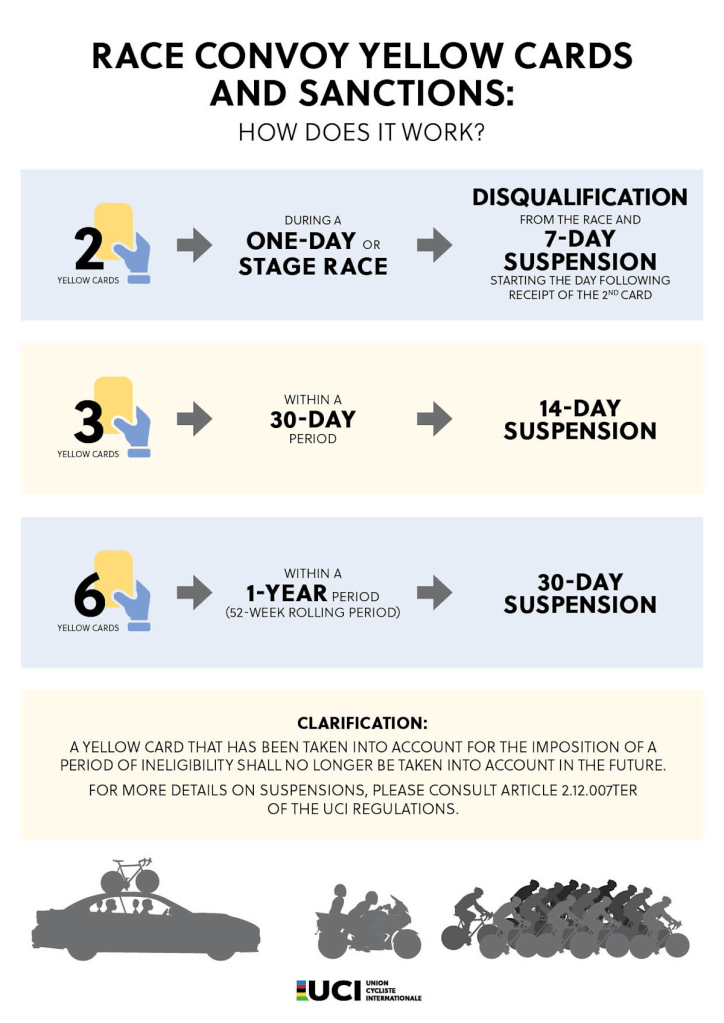
Image Credit: Union Cycliste Internationale
Introduction
Last year the UCI announced the trial of a new yellow card system (see previous blog post here). That trial concluded at the end of 2024, with the ‘full’ system coming into effect on 1 January 2025.
It would be fair to say that the new system has been a rather mixed bag. So what is going wrong, and what changes might be necessary to improve on the current system?
First, a look at the new regulations themselves.
The New Regulations
The new system was formally introduced via the addition of two new Articles 2.12.003bis and 2.12.007ter to Part II (Road Races) of the UCI Cycling Regulations (the “UCI Regs”).
Article 2.12.003 bis reads (so far as is relevant):
Commissaires shall issue yellow cards in situations provided for in article 2.12.007 bis whenever the behaviour concerned is susceptible of causing a risk for safety. The commissaires shall assess the behaviour of the licence-holder concerned to determine if it was susceptible of causing a risk for safety and, if so, shall issue a yellow card. Where the behaviour warrants the other sanctions provided for in the table of race incidents being applied, the yellow card shall be issued in addition to the other sanctions. Where the behaviour does not warrant the other sanctions provided in the table of race incidents being applied, the yellow card shall be issued in isolation.
Yellow cards shall only be issued to individuals. In cases where sanctions are imposed under article 2.12.007 and the person who carried out the relevant action cannot be identified the Sport Director in charge of the team shall be required to identify such person and inform the commissaires’ panel accordingly. In case of failure to do so, a fine of CHF 2’000 shall be imposed on the team or the Sport Director in charge of the team. Yellow cards shall be noted in the communiqué of the commissaires’ panel.
…
In short, Article 2.12.003 bis requires race commissaires to issue a yellow card (“…shall issue a yellow card…”) for any sanctionable behaviour provided for in Article 2.12.007 of the UCI Regs, where the behaviour concerned is “susceptible of causing a risk for safety” in the assessment of the commissaires.
The yellow cards are to be imposed in addition to any sanctions already provided for in Article 2.12.007, or where no such sanctions are warranted, in isolation.
Article 2.12.007ter reads (so far as is relevant):
In case a licence-holder receives 2 yellow cards during the same event, they shall be excluded (in case of a stage race) or disqualified (in case of a one-day race) from the event and be suspended for a period of 7 days.
In case a licence-holder receives 3 yellow cards within a period of 30 days, they shall be suspended for 14 days. For the avoidance of doubt, in case the third yellow card received within 30 days is simultaneously the second received during the same event, only the 14-day suspension according to this paragraph shall apply.
In case a licence-holder receives 6 yellow cards within a period of one year (52-week rolling period), they shall be suspended for 30 days. For the avoidance of doubt, in case the sixth yellow card received within one year is simultaneously the second received during the same event or the third received within 30 days, only the 30-day suspension according to this paragraph shall apply.
The starting date of any suspension imposed according to the paragraphs above shall be the day after receipt of the yellow card triggering the suspension whenever such yellow card is also the second received during the same event. In all other circumstances, the starting date shall be the day after the end of the event or the last stage in which the licence-holder takes part.
Any yellow card that has been counted for the imposition of a period of suspension shall no longer be considered.
In case a period of suspension starts during a stage race, the rider shall be excluded from the event. The UCI points gained until the day of participation in the stage race shall be maintained.
The effective period of any suspension under this article shall only apply within the dates of the UCI WorldTour calendar for men and UCI Women’s WorldTour calendar for women. The effective period of a suspension shall therefore be suspended from the day after the last day of the UCI WorldTour and UCI Women’s WorldTour calendars until the day before the beginning of the UCI WorldTour and UCI Women’s WorldTour calendars of the following season.
…
Article 2.12.007ter then sets out the consequences for receipt of multiple yellow cards, in essence being:
- Receipt of 2 yellow cards during the same event results in exclusion (in the case of a stage race), or disqualification (from a one-day race), and a suspension from racing for 7 days.
- Receipt of 3 yellow cards within a 30-day period results in a suspension from racing for 14 days.
- Receipt of 6 yellow cards within a period of 1 year results in a suspension from racing for 30 days.
- The penalties for receiving 2 and then 3 yellow cards are not cumulative, nor are the penalties for receiving 3 and then 6 yellow cards, e,g. in the event that the second yellow card in a race is also a rider’s third, only the longer period of suspension applies.
- The rules operate in accordance with the principle of ne bis in idem (aka “double jeopardy”) in that as soon as a yellow card has been applied to the result that a period of suspension has been imposed, that yellow card can no longer be taken into account for the purposes of any future suspension. For example, were a rider to receive 3 yellow cards within 30 days and receive a 14-day ban, then those yellow cards would not be counted towards the sanction for receiving 6 cards in a year.
- The starting date of any suspension is the day after the end of the event or last stage in which , save where the yellow card is the second received during the same event, in which case the start date is the following day.
Article 2.12.007 itself also underwent some revisions, most notably the addition of a new type of “race incident”/offence at section 5.2, as below:
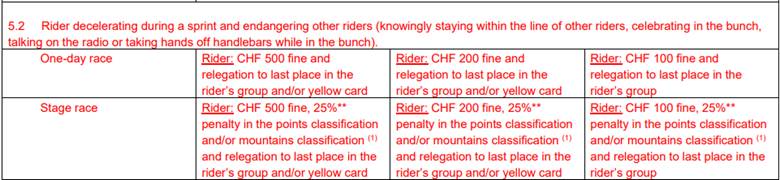
The wording of the new provision is perhaps open to some interpretation. The ‘core’ behaviour is “decelerating during a sprint and endangering other riders”. The words in brackets after that, “knowingly staying within the line of other riders, celebrating in the bunch, talking on the radio or raking hands off handlebars while in the bunch” are (presumably) expressed to be examples of potential behaviour that could meet that definition, but could equally be read as examples of behaviour that in the view of the UCI will always meet that definition. Clearly one interpretation is more sensible than the other.
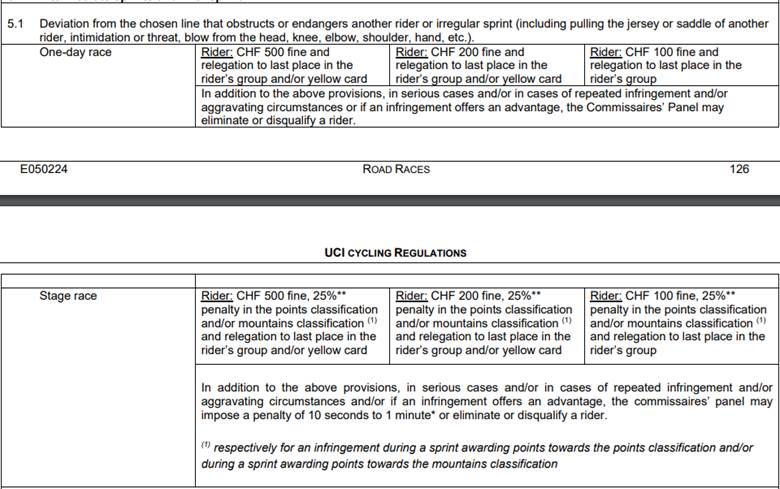
In any event, 5.2 has been applied a number of times since the new yellow card rule formally came into force, alongside the other sprint offence 5.1 (deviation that endangers another rider or irregular sprint):
In conjunction with the rules formally coming into force, the UCI now also maintains a public list of all yellow cards that have been handed out, including a ‘league table’ showing number of yellow cards awarded over the last 30 days and 365 days: https://www.uci.org/discipline/road/6TBjsDD8902tud440iv1Cu?tab=yellowcards
Given that the reports of race juries are frequently not published, that is welcome news to those of us who are nerdy enough to want to keep track of such things.
So far, Danny Van Poppel of Redbull-Bora-Hansgrohe is leading the rather ignominious list after separate yellow cards awarded at the Tour Down Under and UAE Tour for (what were clearly intentional) sprint deviations.
Kaden Groves of Alpecin Deceuninck meanwhile became the first rider to be found to have contravened 5.1, celebrating his teammate Jasper Philipsen’s (long time coming) victory at Kuurne-Brussel-Kuurne.
What is going wrong?
There are essentially three key issues with how the yellow card system is currently functioning: the rules being misapplied, (relatedly) the rules being applied inconsistently, and certain sanctions being ineffective.
A. Rules being misapplied – in particular yellow cards being awarded when there is no behaviour “susceptible of causing a risk to safety”
Looking at two examples:
- Kaden Groves, Kuurne-Brussel-Kuurne. For celebrating his teammate’s win before crossing the line, Groves received a sanction under (new) 5.1 and a yellow card. That is despite that celebration ostensibly endangering absolutely no one. Yes he took one hand off the bars to punch the air, but the main sprinters were all ahead of him by that point and he maintained his line. This should not have resulted in a sanction at all, yet alone a yellow card.
- Maxim Van Gils, Milan-San Remo. For disposing of a bottle in a dangerous way, Van Gils received a 500 CHF fine, was docked 25 UCI points, and received a yellow card. However, 8.3 only provides for a yellow card for this offence for a second infringement, so it was improperly awarded.
B. Rules being applied inconsistently – even when there has been behavior “susceptible of causing a risk to safety”, yellow cards are not always being handed out.
Looking at two more examples:
- Danny Van Poppel, Stage 2 of the Santos Tour Down Under. A clearly dangerous move, during the sprint Van Poppel finished his leadout for Sam Welsford, looked over his shoulder, and then (seemingly intentionally) moved into the line of Tobias Lund Andresen to block his sprint. The application of 5.1 (sprint deviation) resulted in a fine, him being docked points in the points and KOM classifications, and relegated to the back of the group. As 5.2 necessarily entails a rider had “endangered other riders”, there was clearly behaviour “susceptible of causing a risk to safety”, and as such Van Poppel also received a yellow card.
- Laurence Pithie, Stage 4 of the Santos Tour Down Under. Another Redbull rider. This time Laurence Pithy, who having almost put Henri Uhlig into the barriers was sanctioned for contravention of 5.1 (sprint deviation) and was fined, docked points in the points and KOM classifications, and relegated to the back of the group. However, despite having received a penalty for endangering other riders, no yellow card was awarded.
Taken together with the yellow cards in section (A) we therefore have four entirely inconsistent outcomes: two where the riders should have received sanctions and yellow cards (but only one yellow card handed out); one where a rider shouldn’t have received any sanction, but did, and also received a yellow card; and one where the rider did receive an appropriate sanction, but should not have received a yellow card.
C. Ineffective sanctions – it has become clear the majority of ‘cumulative’ penalties are not fit for purpose. Whilst the “two yellow cards in one race” rule is likely effective in deterring multiple infractions during a stage race, the penalties for obtaining 3 yellow cards in 30 days or 6 yellow cards in a year are simply not sufficient or effective for achieving the aim of discouraging dangerous behaviour.
When it comes to the “3 in 30 days” rule, it would be fair to say that barring the extraordinary, it is extremely unlikely any rider will ever fall foul of this. With most riders completing 50-70 race days per year (with a few outliers either side), and most races having a 5-6 day gap in-between them, it is difficult to see a situation in which this rule would apply. Even if, exceptionally, a rider did manage to get 3 within 30 days, the impact of a 14-day suspension on a rider’s calendar is relatively minimal.
As for any rider getting 6 yellow cards within a year – plainly a suspension of longer than 30 days is warranted for anyone endangering other riders that many times within that period.
How to fix it?
The scheme is new, and the trial period was probably not long enough for the UCI to really learn any concrete lessons. However, from the issues that have arisen so far this season, there are a few clear areas where some changes would likely improve the system:
- Scrap the “3 in 30 days rule” and replace it with something more effective. It is very unlikely to ever apply, and even if (exceptionally) it did, the sanction needs to be meaningful. If the goal of these rules is to regulate behaviour the threat of a sanction needs to last longer. I would suggest 3 yellow cards in 60 days, resulting in a 30-day ban from riding, would be a more effective rule.
- Increase the suspension to 60 days for a rider who is awarded 6 or more yellow cards in a single year. As a reminder, that would have been a rider who endangered others frequently throughout the applicable period. The penalty should reflect the repeated nature of the sanctioned behaviour.
- Provide better training for race officials on the application of the new rules. The system is new and will take time to bed in, but if it is to work it needs to be applied properly and consistently.
- Make the award of the yellow card reviewable. With serious sanctions come the need for a mechanism to ensure that yellow cards are being awarded correctly. The review need not be onerous, and isn’t me looking for a new workstream either. It could just be an administrative process done on submission of a form.
Concluding thoughts
Fundamentally, the yellow card system has a postive aim: keeping riders safe through reducing the prevalence of dangerous behaviours during races. However, whilst it is easy to criticise from the sidelines, there are also some obvious issues with how it currently functions. If it is going to achieve its intended aim, the UCI needs to address these issues sooner rather than later.
Words: Nick Williams

 Cycle Counsel
Leave a comment